 Ape swap
Ape swap approval and trade cancellation boundaries
Ape swap trades can be stopped before submission when the wallet has only confirmed a separate token approval. That approval permits spending; it does not execute the exchange. Once a swap is pending, cancellation becomes a race to replace it before execution. A successfully confirmed swap cannot be undone through the wallet, and revoking permission cannot reverse its transfers.
The project rebranded as ApeBond, whose swap service uses aggregation and can include bridging. The stopping point therefore depends on the action that you authorized and its execution state, rather than the name displayed beside it.
The quote, the approval, and the exchange result
A quote describes the proposed exchange, while a separate token approval establishes permission to spend the input token. The swap transaction requests execution using the selected input and the output conditions that its call contains. Reviewing a quote or confirming an allowance does not, by itself, establish that the exchange occurred.
Before authorizing execution, check the input amount, recipient, and minimum output that the transaction will enforce. Slippage settings affect that output condition, not the ability to undo a completed trade. Afterwards, the execution record and resulting token transfers establish what happened. An approval confirmation answers a different question: whether the spender received permission.
The transaction record that identifies your stopping point
The transaction hash identifies a submitted operation, but its receipt determines whether execution succeeded or failed. Match the record to the wallet account and network involved. Then distinguish a token approval from a swap call by inspecting the decoded action and its parameters, rather than relying on a generic wallet notification.
An approval record identifies the token, spender, and authorized amount. A swap record can include contract calls and token transfers associated with execution. The spender named inside an approval may differ from the token contract that receives the approval transaction. Confusing those addresses can lead to reviewing the wrong permission.
Keep the relevant hashes before clearing local activity. A pending label in one application can lag behind the network, and a missing receipt alone does not prove cancellation.
Can I stop after approving the token?
Yes, when you have confirmed only a separate approval and have not submitted a swap or executable trade authorization. You can decline the subsequent swap request without exchanging the tokens. The approval transaction remains part of the chain history, and its spending permission may remain active.
A standard ERC-20 approval authorizes a specified spender to transfer tokens up to the allowance. It does not reserve a quote or limit spending to the trade that you intended. The spender contract’s code determines how that permission can be used. If you abandon the exchange, removing an unwanted allowance addresses that remaining permission.
Rejecting a new wallet prompt affects that request only. It does not retract a transaction or signature that you already submitted.
Signed permits change what an approval looks like
A signature request can authorize token spending without immediately producing an approval transaction in your wallet history. Where a token and execution path support permits, another party can submit the signed authorization later. The absence of a gas payment at signing does not make the signature harmless or automatically revocable.
ERC-2612 permits contain an owner, spender, amount, deadline, and nonce. The nonce identifies the authorization state that must match when someone submits the permit. Its deadline limits submission validity; it does not necessarily expire the allowance created through a successful submission.
Do not assume that every ApeBond route uses this mechanism. Inspect the actual request. A plain allowance revocation may leave an unused permit valid if its nonce and deadline still permit submission. Cancelling such an authorization requires the invalidation mechanism supported by that token or signing system.
Can a pending swap still be cancelled?
A pending swap may be cancelled if a valid replacement reaches execution before the original transaction. For ordinary transactions from an externally owned account on an EVM network, replacement uses the same sender and nonce. The nonce is the account’s transaction sequence number.
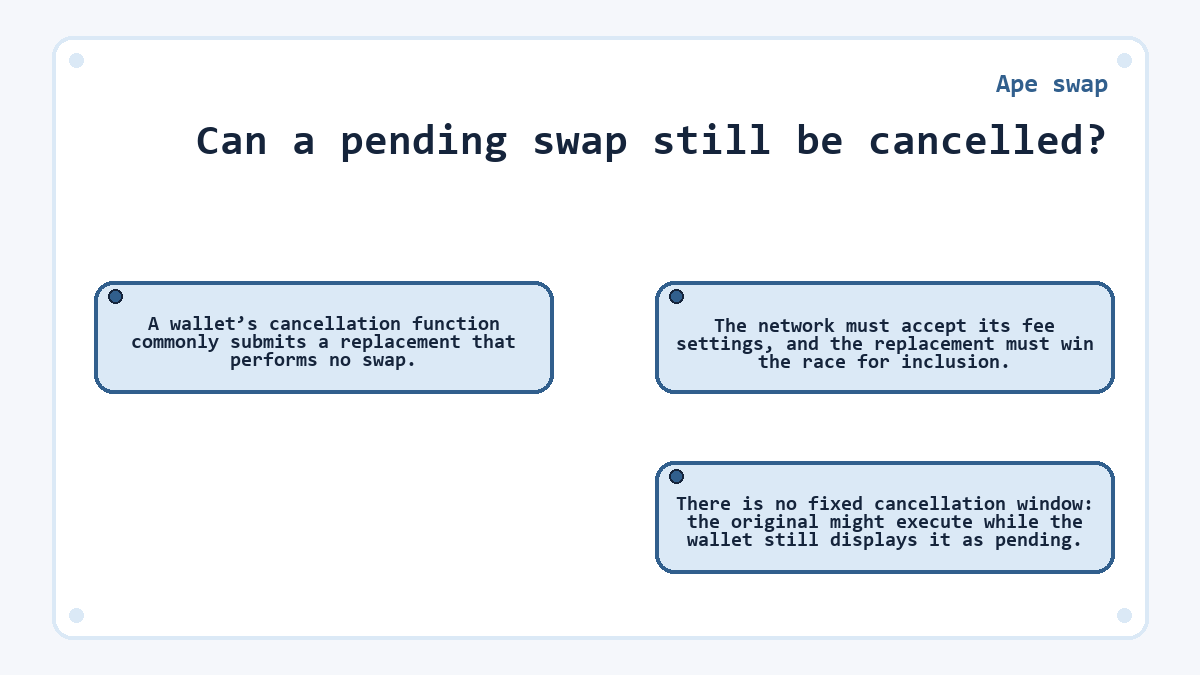
A wallet’s cancellation function commonly submits a replacement that performs no swap. The network must accept its fee settings, and the replacement must win the race for inclusion. There is no fixed cancellation window: the original might execute while the wallet still displays it as pending.
Speeding up and cancelling have different effects. Speeding up resubmits the intended operation with adjusted fees. Cancellation attempts to replace that operation. Confirm the action that the wallet proposes before signing, especially when several transactions await execution.
A later transaction from the same ordinary account cannot skip an earlier nonce. Consequently, submitting a revocation behind a pending swap does not make it an effective cancellation. Smart accounts, bundled operations, and private submission services can have different controls; use their supported cancellation mechanism rather than assuming that manual nonce replacement applies.
Revocation, replacement, and disconnection affect different things
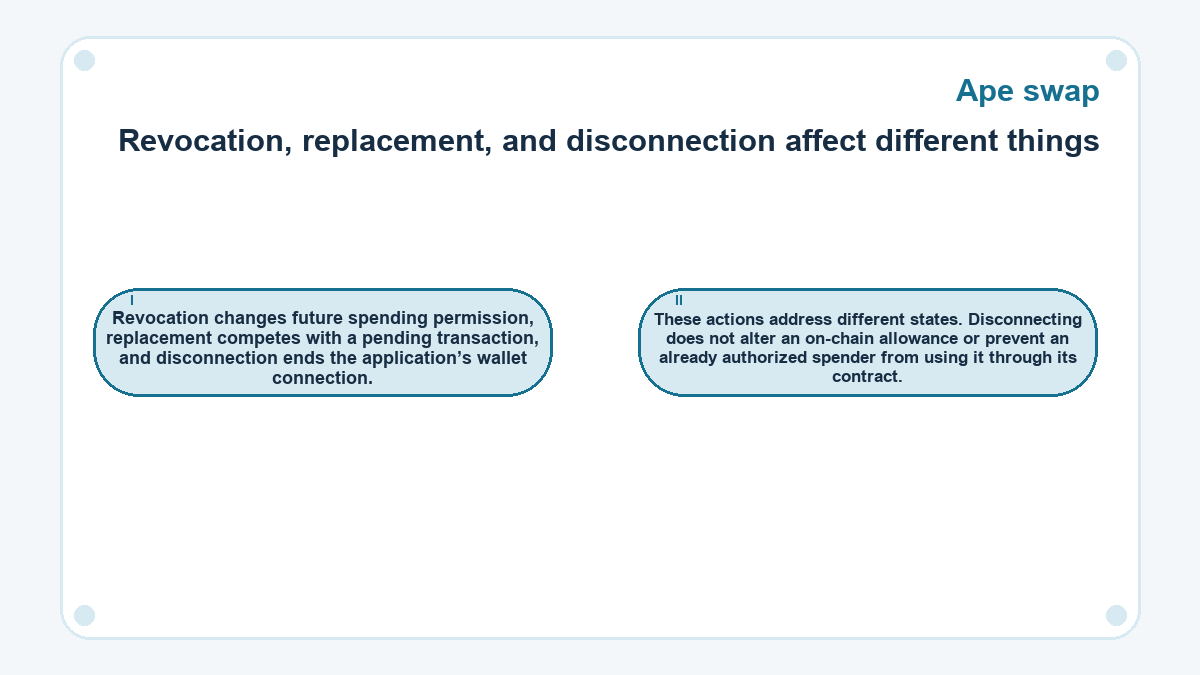
Revocation changes future spending permission, replacement competes with a pending transaction, and disconnection ends the application’s wallet connection. These actions address different states. Disconnecting does not alter an on-chain allowance or prevent an already authorized spender from using it through its contract.
For a standard ERC-20 allowance, revocation sets the selected spender’s allowance to zero. That change takes effect only after successful execution. It cannot recover tokens transferred earlier, and a spender may use the existing allowance before the revocation confirms. Check the resulting allowance for the correct token and spender rather than treating the submitted request as completion.
The cost of stopping before execution
Declining an unsigned swap request does not submit a transaction or incur a network execution fee. A confirmed approval has already consumed gas, even if you abandon the trade. An executed cancellation replacement or revocation also consumes gas. The network’s fee conditions and the executed operation determine that cost; approval fees do not become a refundable deposit against a later swap.
A changed quote before and after swap submission
In this hypothetical example, the reader keeps the input token and amount unchanged but decides to stop before or after submitting the swap. A separate approval has confirmed. The reader accepts the exchange only if its enforceable minimum output meets the amount they are willing to receive. No asset, amount, or fee here represents a live quote.
Before submission, the refreshed quote no longer meets that condition. The reader declines the swap request. No swap transaction enters the network, so this attempt exchanges no input tokens. The confirmed approval remains, and the reader submits a revocation because they no longer want the spender to retain access.
The reader never submitted the swap. Successful revocation and a zero allowance confirm that the selected spending permission has ended. The approval and revocation records remain visible, together with their gas costs.
Change only the timing: the reader has already submitted the swap when they decide to stop. A cancellation replacement is now an attempt rather than a certain exit. If that replacement confirms first, the original swap cannot execute with the same account nonce. If the swap executes successfully first, cancellation cannot reverse it. The reader must assess the received tokens; any exchange back would require a new quote and transaction.
A failed transaction and the boundary for retrying
A failed swap receipt means that the submitted transaction did not complete successfully, which differs from a successful cancellation replacement. A top-level EVM transaction revert rolls back the state changes made by its EVM execution. It does not undo a separate approval that confirmed earlier.
Gas already consumed remains a cost. Before retrying, distinguish a confirmed failure from an unresolved pending transaction. Another submission with a different nonce can create another executable trade if the earlier transaction still succeeds. A refreshed quote also requires a fresh decision about its output condition.
When the transaction failed because a required condition did not hold, identify that condition before changing settings. Increasing slippage tolerance does not resolve a missing allowance, and submitting another approval does not cancel a pending swap.
Bridging moves the recovery boundary beyond the wallet
A route involving another chain can continue processing after its source transaction confirms. At that point, the wallet cannot replace the confirmed source transaction to retrieve the original input. Stopping an outstanding wallet request affects only the action that still requires that request.
Recovery then depends on the bridge and the route’s actual state. A failed destination exchange can leave a different token delivered, while other failures may lead to a refund or require a supported recovery action. Neither a source confirmation nor a generic failure message establishes the final outcome. Locate the received or refunded asset before authorizing another exchange, and do not treat revocation as a bridge refund request.
The permissions and records that remain afterwards
Stopping the trade and removing its unused permissions are separate outcomes. After a cancellation replacement succeeds, inspect any allowance that an earlier approval created. A successful trade may also leave an allowance, depending on the authorized amount and the token’s allowance accounting.
Retaining permission can avoid another approval transaction when the same spender needs access later. Removing it ends that access but can require a fresh approval for a future exchange. That choice concerns future use, not the status of the trade that you stopped.
Preserve the original transaction hash, any replacement hash, and the revocation receipt where applicable. For submitted operations, those records distinguish a replaced transaction, a failed execution, and a completed exchange. An unsigned request that you decline has no on-chain transaction record. Once execution has succeeded, selling the received tokens creates a new trade with new costs and market exposure.
What readers ask about Ape swap
Does an expired swap quote also expire the token approval?
An expired quote does not automatically expire a standard ERC-20 allowance. The quote describes proposed execution terms, while the token contract stores the spending permission separately. A token or authorization system may implement expiry rules, but the basic allowance mechanism has no quote-linked deadline. Check the remaining allowance when abandoning an old quote.
Will a hardware wallet prevent spending after I approve a token?
A hardware wallet does not require another device confirmation when a spender uses permission that you already granted. The device protects signing keys, while the token contract enforces the allowance. Turning off or unplugging the device therefore does not revoke approval or prevent a previously authorized contract from using that allowance.
Can clearing wallet activity cancel a transaction that looks stuck?
Clearing local wallet activity does not cancel a transaction on the network. It changes the wallet’s local record and can remove useful information about pending operations. Preserve the transaction hash and establish its network status before resetting anything. A genuine cancellation requires the applicable replacement or cancellation mechanism to succeed.
Which permission matters when a refreshed route requests another approval?
The permission for the refreshed route’s actual spender matters. An existing allowance for a different spender does not automatically cover the new route, even when the input token remains unchanged. Review the new request separately. Granting it also does not remove the old spender’s allowance, so abandoning the original route can leave an additional permission active.
Why can a revocation request still display the word approve?
Standard ERC-20 revocation uses the approval function with an allowance of zero. A wallet may therefore describe the request using approval terminology even though it removes spending permission. Inspect the spender and resulting allowance in the request. The function name alone does not distinguish granting access from revoking it.
Is an approval on another network affected by revoking this one?
Revoking an allowance on one network does not revoke an allowance on another network. Each token contract maintains its own permission state, even when the same wallet address appears on both networks. Review the network associated with the original approval before interpreting a zero allowance elsewhere as evidence that spending access has ended.
How does a failed revocation affect the existing allowance?
A reverted revocation does not apply the requested allowance change. The previous permission remains unless another successful operation changes or consumes it. Inspect the failure and read the current allowance before retrying. A wallet notification that the revocation was submitted establishes an attempt, not the removal of spending access.