 Ape swap
Ape swap slippage settings and received token checks
Ape swap slippage settings limit the accepted fall in output from a swap quote. Read the displayed minimum before confirming, then compare the completed transaction with the tokens received. A tighter limit can reject an otherwise executable swap, while a wider limit permits a less favorable result.
A usable route with an acceptable output floor
Choose a quoted route only when its output token, receiving network, and minimum amount match the intended exchange. The ApeBond swap interface provides token and network selection alongside expandable trade details. Its transaction record and the receiving balance provide the evidence needed afterward. Compare the amount entered, slippage tolerance, and minimum received; a bridge route adds separate destination processing that a same-chain swap does not require.
How does slippage tolerance change the minimum received?
Increasing tolerance generally lowers the minimum accepted output for an unchanged exact-input quote, allowing execution through a larger adverse price movement. The estimated output remains a quote, while the minimum sets the execution boundary. Read both amounts together whenever a setting changes.
The quoted amount and the accepted minimum
Keep the input amount fixed when comparing tolerance settings. Otherwise, a different trade size can change the quote and obscure what the setting changed. Increasing slippage tolerance widens the accepted execution range without preventing exchange-rate changes.
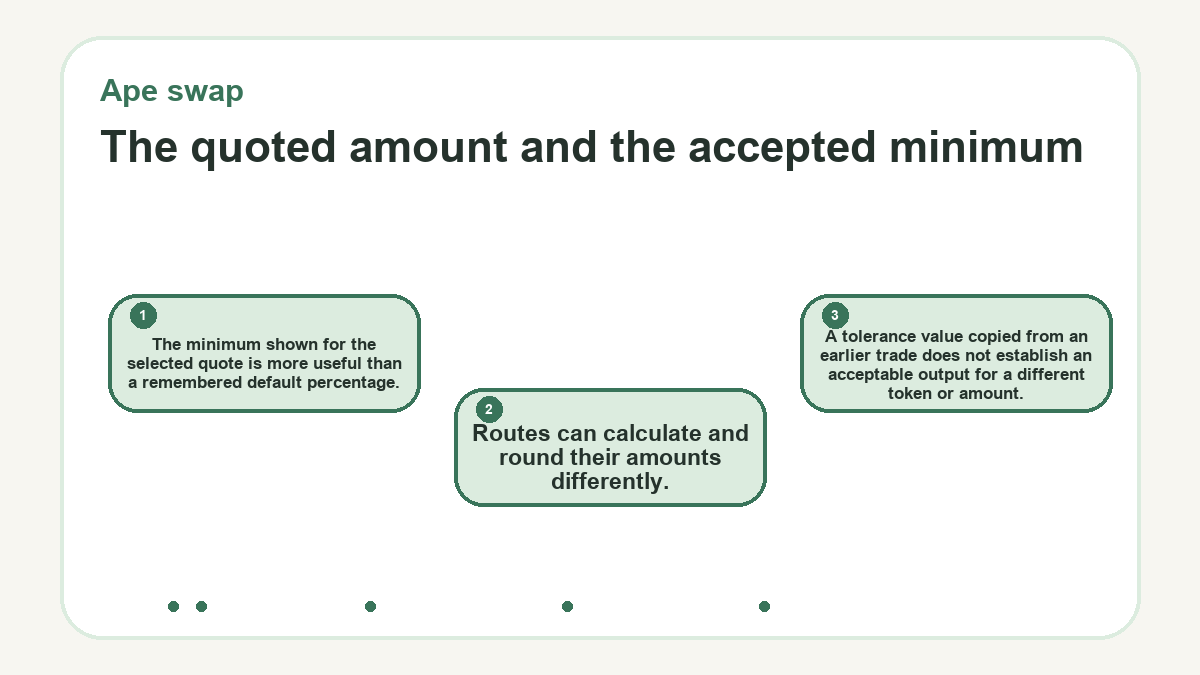
The minimum shown for the selected quote is more useful than a remembered default percentage. Routes can calculate and round their amounts differently. A tolerance value copied from an earlier trade does not establish an acceptable output for a different token or amount.
The details reviewed before confirmation
Expand the trade details before signing and inspect the input amount, estimated output, and minimum received. Check any displayed charges separately. If the quote refreshes during this review, compare its new minimum with the amount you were prepared to accept. A familiar percentage can accompany a worse quote.
Does a higher tolerance fix price impact?
A higher tolerance does not improve the liquidity or pricing that produced the quote. Price impact concerns how the trade interacts with available liquidity, whereas slippage tolerance controls the accepted movement around the quoted result. Raising tolerance can permit an unfavorable execution without improving its economics.
Changing the entered amount produces a new quote that can reveal how pricing changes with trade size. Compare output per input token, rather than total output alone. Reducing the amount may reduce price impact, but the new quote must demonstrate that improvement. Splitting an exchange also creates additional transactions and their associated costs.
A quoted minimum and a received amount
Consider a hypothetical same-chain swap with a fixed input amount and an ordinary output token without transfer deductions. Every amount in this example is hypothetical: the quote shows 247.5 output tokens, the displayed minimum is 245.3, and successful execution delivers 246.1.
The received amount sits 1.4 tokens below the estimate and 0.8 above the minimum. The minimum-output check therefore accepts that result. Compare each execution with its submitted minimum; a new quote or tolerance setting can change that minimum.
If the same hypothetical swap could deliver only 244.9 tokens, it would fall below the minimum. The protected swap would therefore revert. Increasing tolerance would authorize a different boundary; it would not recover the original exchange rate.
After verifying that the transaction failed, obtain a fresh quote before considering another submission. Stop if its minimum is unacceptable. For the successful case, the execution record and a matching 246.1-token credit establish the result, provided no unrelated balance changes occurred during the comparison.
Matching the transaction record to the received tokens
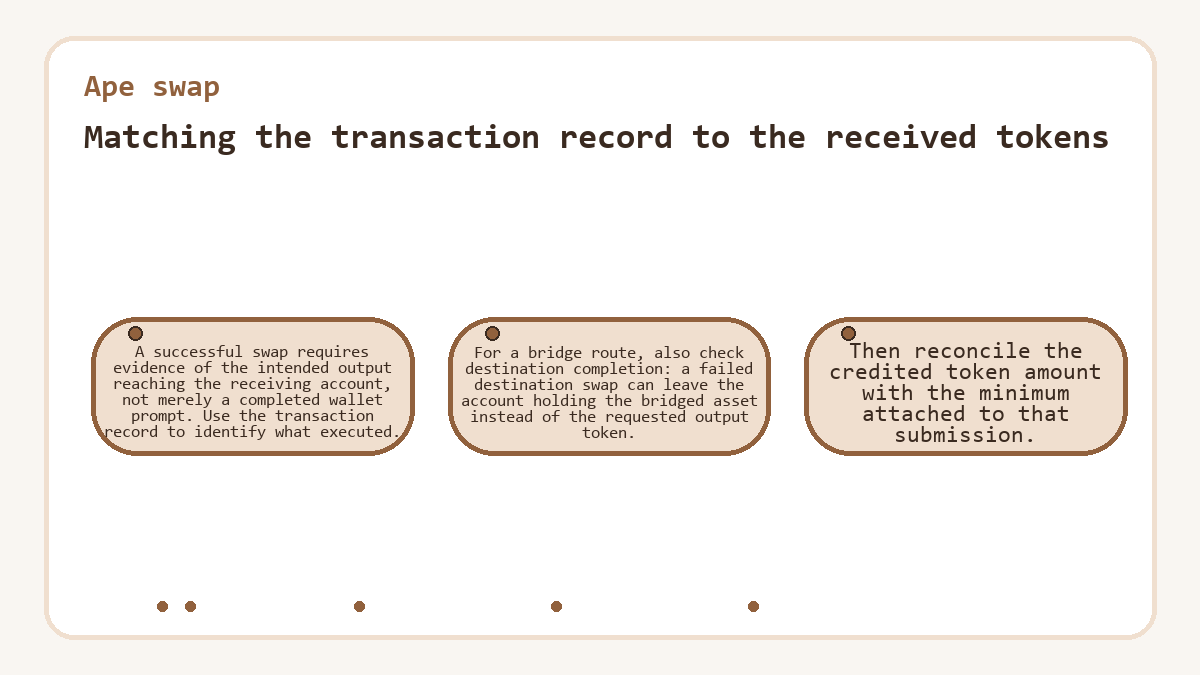
A successful swap requires evidence of the intended output reaching the receiving account, not merely a completed wallet prompt. Use the transaction record to identify what executed. For a bridge route, also check destination completion: a failed destination swap can leave the account holding the bridged asset instead of the requested output token. Then reconcile the credited token amount with the minimum attached to that submission.
The receipt and token transfers
An EVM transaction receipt reports whether the transaction succeeded or failed. A successful approval transaction sets the spending allowance and does not establish that the exchange completed. For the swap itself, inspect the receiving account and asset in the transfer details. For an ERC-20 output, verify its token contract; for a native asset, inspect the native-currency transfers.
Match the network and asset to the selected output, including the contract address for an ERC-20 token. A shared symbol does not establish token identity. Compare token units with token units, using the correct decimal precision. A wallet’s changing currency valuation cannot establish how many tokens the swap delivered.
The balance change and display delay
When no other activity affects the output token, subtracting the earlier balance from the later balance provides a useful reconciliation. Other incoming transfers, spending, or token supply adjustments can invalidate that shortcut. If the output is the network’s native currency and the receiving account also pays gas, account for that fee when reconciling the balance. In those cases, isolate the swap’s transfers instead of attributing the entire balance change to one exchange.
A wallet may omit a token that the account already holds. Check the account on the receiving network before treating an empty asset list as a failed swap. Adding the correct token to the wallet display changes visibility; it does not execute another exchange or move funds.
Which failures justify changing the setting?
A confirmed minimum-output failure makes the quote and tolerance relevant; an allowance, gas, or token-transfer failure requires a different remedy. Read the transaction error before changing settings. A generic failure message does not establish that the permitted price movement was too narrow.
Refreshing a stale quote can resolve a mismatch between the displayed estimate and available execution. A wide slippage tolerance can increase exposure to sandwich attacks. In such an attack, surrounding trades manipulate execution against the permitted range. Raising tolerance repeatedly can therefore increase the loss that a successful transaction accepts.
Transfer restrictions or unsupported token behavior need separate investigation. A more permissive price setting cannot remove a contract restriction. Keep any proposed adjustment tied to the actual failure and the newly displayed minimum.
Tighter limits, fresh quotes, and the stopping point
A tighter tolerance narrows the accepted output range and increases the chance of rejection when prices move adversely. A fresh quote updates the proposed exchange without requiring a wider tolerance. Compare these choices through the resulting minimum, then leave the transaction unsigned if neither gives an acceptable amount. Review the setting again whenever the token, amount, or route changes; acceptance of one quote does not carry over to the next.
Helpful answers about Ape swap
-
Is the slippage percentage charged as an extra swap fee?
- Slippage tolerance is an execution limit, not a separate percentage fee charged for every swap. The actual difference between quoted and received output can be smaller than the permitted tolerance. Route charges and network transaction costs have separate causes, so increasing tolerance does not purchase faster processing or pay for better pricing.
-
Can the received amount exceed the original quote?
- A minimum-output condition does not itself cap the received amount at the estimate. Whether favorable price movement reaches the recipient depends on the selected route and its execution terms. Treat the quote as an estimate and use the completed transfer amount to establish what arrived.
-
Will zero slippage tolerance always make a swap fail?
- Zero tolerance does not inherently require failure, but it leaves no room for adverse movement relative to the applicable output boundary. Execution may succeed if it meets that boundary. Availability of a zero setting and the exact minimum calculation depend on the interface and route, so inspect the displayed minimum.
-
Does changing slippage after signing alter a pending swap?
- Changing an interface setting does not rewrite the parameters of an already signed transaction. The submitted transaction retains its encoded execution conditions. Establish its status before submitting another exchange, because a new quote or changed setting does not prove that the earlier transaction has stopped.
-
How should I compare quotes after reversing the input and output tokens?
- Reversing the tokens creates a different exchange with a minimum denominated in a different output token. Compare each quote against its own input amount and received-token units. The same tolerance percentage does not make the exchanges equivalent, because liquidity, fees, and the direction of the trade can affect their results.
-
When can a later balance differ from the amount received during the swap?
- Later transfers, spending, or a token’s supply-adjustment mechanism can change the balance after settlement. Those changes do not by themselves show that the swap breached its minimum. Compare the transaction’s credited amount with its submitted terms, and distinguish that settlement record from the account’s balance at a later time.